One of the most crucial choices an Amazon seller, retailer, or expanding e-commerce enterprise must make is finding wholesale suppliers for resellers. A key term that buyers will come across when trying to compare suppliers is MOQ – Minimum Order Quantity. Although it might seem like just a number, MOQ can significantly affect cash flow, inventory control, product testing, and years-long profits.
The reasons why businesses are interested in seeking wholesale suppliers with low MOQ are quite clear. A lower minimum may enable you to buy products without committing a lot of money right up front. This may be helpful if it's time to launch a new product, trial a new product category you're not familiar with, or get started with a limited number of products on Amazon FBA.
But what exactly is meant by “low MOQ”? The number of items that are low for one product category may be relatively large for another. A low minimum doesn't mean it's the most important thing, but if you have a high MOQ, it may not be appropriate for your company.
This guide will help you understand what exactly is meant by the term low MOQ, understand how minimum orders work, and compare suppliers, as well as learn what Amazon sellers should look for before signing up with a wholesale partner.
What Is an MOQ?
MOQ is Minimum Order Quantity. It is the minimum amount that a supplier will require a buyer to order at one time.
Suppose a supplier provides a certain beauty product at $10 per unit and offers a minimum order quantity (MOQ) of 100. Suppose that a supplier offers a certain beauty product at $10 per unit and has a minimum order quantity (MOQ) of 100. The minimum amount the buyer would have to buy before even thinking about shipping, taxes, etc., would be $1,000 for the minimum 100 units.
There are a number of different ways to organize MOQs. A supplier can set minimums on the number of units per product and/or a minimum dollar amount per order.
For example:
| MOQ Structure | Example |
|---|---|
| Per-SKU MOQ | 50 units of each product |
| Order-value MOQ | $1,000 minimum order |
| MOQ Structure | Example |
|---|---|
| Category MOQ | 100 units across a product category |
| Mixed-product MOQ | 100 total units across multiple SKUs |
Understanding the structure is important because two suppliers advertising the same numerical MOQ may actually provide very different purchasing flexibility.
What Does “Low MOQ” Actually Mean?
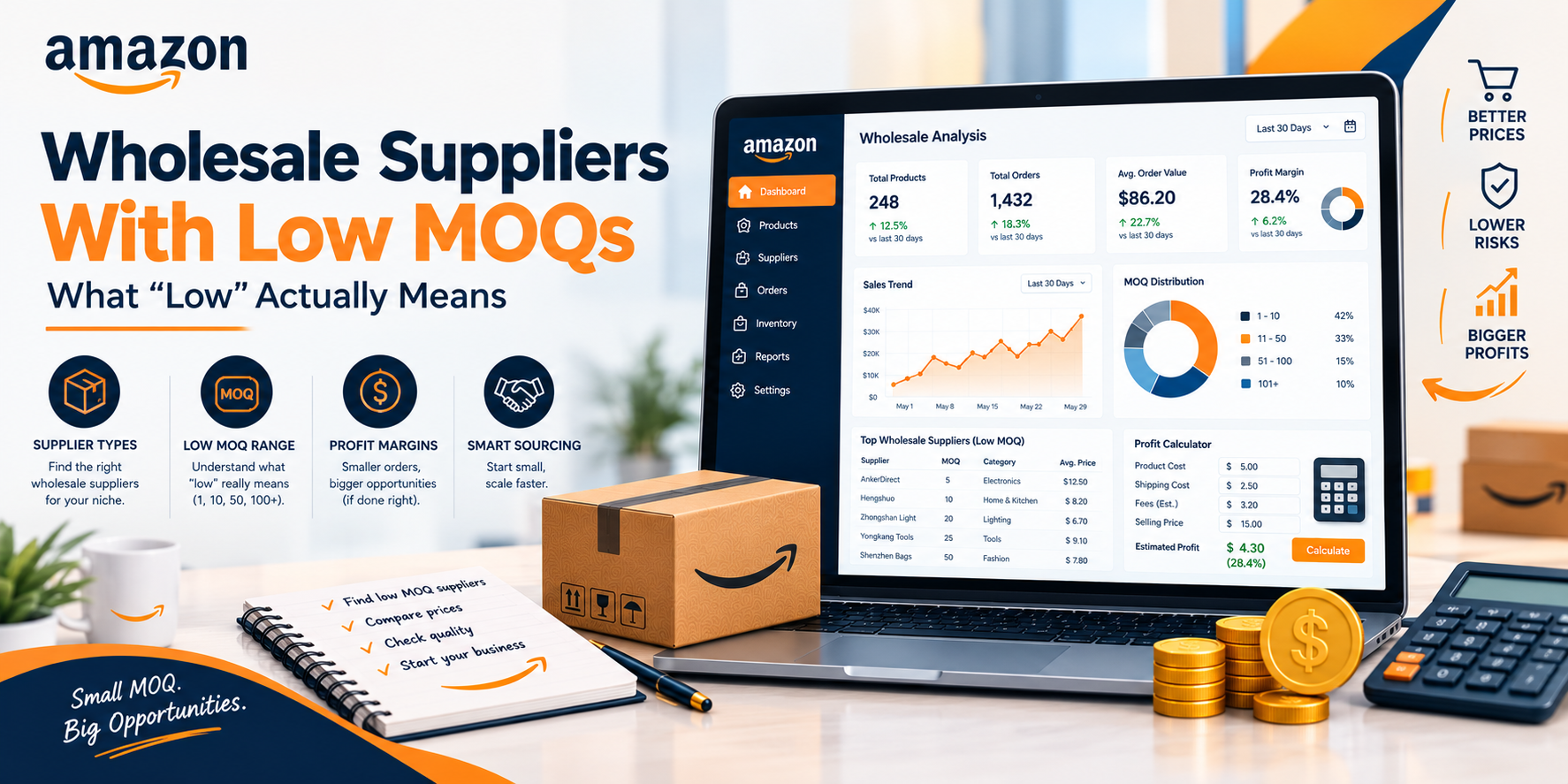
A low MOQ generally means that a supplier allows buyers to purchase a relatively small quantity compared with normal wholesale requirements.
There is no fixed industry-wide number that automatically qualifies as “low.” For some products, 25 units may be considered a low MOQ. For other products, 100, 250, or even 500 units may be relatively low.
The appropriate MOQ depends on several factors, including:- Product category
- Product cost
- Supplier size
- Brand requirements
- Manufacturing process
- Wholesale market
- Buyer volume
- Product demand
- Packaging requirements
This means businesses searching for wholesale suppliers with low MOQ should evaluate the MOQ in relation to the product and their own purchasing capacity rather than relying on the number alone.
While a supplier with a MOQ of 50 units might sound good, it is important to remember that this lower MOQ may not offer any significant price benefit if the wholesale price is significantly higher than that of other suppliers.
So, why do wholesale suppliers require MOQs?MOQs are set for a practical purpose by the wholesale supplier.
The cost of inventory, order processing, packing products, shipping and handling and warehousing operations all contribute to the cost of your business. For some suppliers, it may not be efficient to process orders that are very small.
MOQs can also help offset production set-up costs for manufacturers. For a factory, if they require raw materials or the production equipment needs configuration, they may not be able to be economical if they only produce a few items.
The minimum order values can be set for various reasons by the distributors. They might require a certain number to be worth the time of workers in the warehouse, price to fulfil that order, administration, and/or shipping.
In other words, a supplier with a high MOQ doesn't always mean that he or she is hard to deal with. Often forms part of supplier's business model.
When it comes to Minimum Order Wholesale prices, buyers should look for low Minimum Order Wholesale prices.
If businesses are interested in minimum order wholesale, they need to consider more than just the minimum order.
The MOQ might not be the most advantageous supplier. Rather, it could be able to provide you with sensible minimums, competitive pricing, reliable fulfillment, legitimate products, and business terms that are clearly defined.
When looking at suppliers, keep the following points in mind:
Unit Pricing:The supplier with a low MOQ might be a bit expensive for a wholesale unit price. Maybe another supplier needs a greater quantity but offers a much reduced price per unit.
Product Quality:If the products fail the quality requirements over and over again, a low minimum is not helpful. Product quality may impact customers, returns, reviews, and account performance.
Shipping:When making the final decision on whether you need to send a small order or not, always keep in mind shipping costs. Low MOQ does not necessarily indicate low TLC.
Lead Times:There may be a very nice MOQ however, the supplier may require weeks to fill your order. The longer lead times could lead to planning issues with inventory.
Documentation:Sellers from Amazon should heed to invoices and the supplier's paper documents, especially when procuring branded items.
Availability:Ideally, a supplier will be able to have consistent stock levels. Stock-outs may occur frequently, making it difficult to keep products in stock.
Low MOQ vs. The minimum order wholesale policy is not applicable.
When ordering with low MOQ or no MOQ, it is easy to mix it up with each other.
Low-MOQ supplier is a supplier who demands a minimum amount or order. An online no minimum order wholesale supplier, however, might permit customers to place small orders without there being a particular minimum.
For example:- Supplier A needs 25 pieces.
- Supplier B requires 100 units.
- Supplier C has no minimum quantity.
Supplier C gives the highest purchasing flexibility, however, this does not necessarily mean the most economical purchase.
The no-MOQ supplier might charge a higher price, shipping fee, or other costs per unit. In the meantime, a few suppliers may have a lower MOQ and offer you a better price when the order has reached a certain quantity.
The right one is based on your business model and buying strategy.
Who benefits from MOQ suppliers with low MOQ?
Low-MOQ suppliers can be especially beneficial for companies that are looking for flexibility in their purchasing.
New Amazon Sellers:If you're a new Amazon FBA distributor seller, you may not want to put your money into a product that you don't know how well it will sell. With a smaller order, they can gauge the demand and reduce the initial investment of inventory.
Product Testers:Established vendors can also take advantage of lower MOQs for testing out new brands or product categories.
Small Retailers:Independent stores might not be able to order in the same quantities as large distributors do. Reduced minimums can make getting a good deal easier.
Seasonal Businesses:Small orders may be preferable for businesses selling seasonal items, to avoid having large stockpiles of unsold wares.
Growing E-Commerce Brands:As sales become more predictable, a growing business can start to increase the quantities of orders that it places.
Low MOQ and Amazon FBA.
A wise choice with inventory is essential for Amazon FBA sellers as buying products can impact cash flow and fulfillment planning.
Sellers should make estimates of the inventory they will sell, their product margins, Amazon costs, storage costs, and inventory replenishment needs prior to buying inventory.
This is where Amazon seller calculator tools can be useful. Sellers can estimate potential revenue and expenses before deciding whether a wholesale product makes financial sense.
Inventory planning also requires an understanding of how much inventory to send to Amazon FBA. Sending too much inventory can increase storage exposure, while sending too little may result in stockouts.
A low MOQ can make this balancing process easier because sellers may be able to place smaller replenishment orders.
However, low MOQ should not become an excuse to purchase products without analyzing demand.
How Low MOQ Helps With Product TestingProduct testing is one of the biggest reasons businesses search for wholesale suppliers with low MOQ.
Imagine an Amazon seller identifies five potentially profitable products. Instead of purchasing 500 units of each product immediately, the seller may prefer to purchase a smaller initial quantity where supplier terms allow it.
The seller can then monitor:- Sales velocity
- Conversion performance
- Customer response
- Return rates
- Advertising performance
- Competition
- Profit margins
If one product performs significantly better than the others, the seller can consider increasing the next order.
This approach can reduce the amount of capital committed to products before their demand has been established.
How to Find Wholesale Suppliers for Amazon FBABusinesses researching how to find wholesale suppliers for Amazon FBA should evaluate suppliers systematically rather than choosing a supplier based solely on MOQ.
Start by identifying the product categories and brands you want to source. Then research distributors, wholesalers, and authorized suppliers that serve those categories.
When reviewing a supplier, look for information about:
- Wholesale account requirements
- Minimum order quantities
- Product availability
- Brand relationships
- Pricing
- Shipping policies
- Payment terms
- Documentation
- Return policies
- Business verification
Amazon sellers should also be careful when evaluating unfamiliar suppliers. Extremely low prices or unusually easy purchasing terms do not automatically indicate a reliable wholesale relationship.
Ready to Explore Wholesale Opportunities?
If you want to establish a wholesale purchasing relationship and explore available sourcing opportunities, Apply for Wholesale Account.
How to Find Products to Sell on Amazon FBA
Supplier research and product research should work together.
Businesses learning how to find products to sell on Amazon FBA should first examine potential demand, competition, pricing, fees, and expected margins.
Once a product appears promising, the next step is evaluating whether the supplier's purchasing terms make sense.
For example, a product may appear profitable at retail price, but a high MOQ could require an investment that is uncomfortable for a new seller.
A lower MOQ can therefore make the product easier to test, but the seller still needs to calculate the complete economics of the product.
Low MOQ Does Not Always Mean Better Pricing
One of the most important things to understand about MOQs is that a lower minimum does not automatically equal a better deal.
Consider two hypothetical suppliers:
| Factor | Supplier A | Supplier B |
|---|---|---|
| MOQ | 50 units | 200 units |
| Unit price | $12 | $9 |
| Initial product cost | $600 | $1,800 |
Supplier A requires less initial capital. Supplier B requires a larger investment but provides a lower unit price.
When the capital is there, and an item moves fast, committing to a larger order can yield better per-unit economics. Yet if nobody has tried selling the product yet, keeping the volume down can limit the financial hit.
That trade-off is the reason MOQ must always be evaluated in tandem with expected demand and unit pricing.
Is an MOQ Open to Negotiation?
The amazon fba wholesale distributors are open to talking through order terms on occasion, especially if there is potential for an ongoing business relationship.
Suppliers often budge when buyers show steady reorder habits or commit in advance to buying more down the line.
Possible negotiation approaches include:
- Finding out if multiple SKUs can be bundled together
- Asking for a smaller trial run first
- Bringing up a regular order schedule
- Checking how unit rates drop as quantities go up
- Looking into split-case or mixed-case options
- Finding out if returning buyers get a different MOQ
Negotiation is not an option with every supplier. Some order minimums are pinned directly to distributor contracts or production constraints, leaving very little room to maneuver.
Questions to Put to Low-MOQ Suppliers
Get direct answers about the supplier's terms before you commit to an order.
What is the required MOQ for each product?
A low minimum can look good in an advertisement, but a vendor might still attach it to each SKU on its own. Confirm whether that threshold covers the entire purchase or attaches to each item individually.
Does the order have a minimum dollar amount?
Certain vendors set thresholds for both item counts and overall spend.
Is it possible to combine different products?
Mixed-SKU ordering can make a supplier significantly more flexible for smaller businesses.
How do the terms shift at higher volumes?
Check if your per-unit costs drop as you order more.
How much does shipping run?
The inventory price is only part of what you will ultimately pay for an order.
Which paperwork comes with the order?
Before buying, anyone selling on Amazon needs to know which invoices and supporting paperwork they will receive.
How are payments handled?
Certain suppliers will insist on upfront payment prior to shipping, whereas companies with an established record might be offered alternate arrangements.
Evaluating Amazon Authorized Suppliers
Legitimate sourcing matters even more when dealing with brand-name merchandise.
If you are looking into Amazon Authorized Suppliers, check whether they have documented ties to the actual brand and the paperwork to back it up.
Just because a vendor says their inventory is real does not mean you should take their authorization or legitimacy as a given.
Before putting branded inventory up for sale, buyers need to complete proper due diligence and get a firm grasp of Amazon's rules.
A vendor's MOQ tells you only part of the story when judging a reliable supplier. Genuine goods, proper paperwork, fair prices, and reliable order fulfillment all carry weight.
Typical Pitfalls When Selecting Low-MOQ Suppliers
Hunting for wholesale deals with low minimum order requirements makes sense, but buyers frequently stumble into a few familiar traps.
Choosing Only Based on MOQ:
Securing the rock-bottom MOQ does not automatically mean you got the best deal from a supplier.
Ignoring Unit Economics:
Make sure you factor in product costs, freight, marketplace cuts, ad spend, and any other related outlays every time.
Ordering Too Many Products:
Testing is certainly simpler with a low MOQ, but sellers still should not buy stock without doing the necessary homework first.
Ignoring Supplier Documentation:
Keeping the right paperwork can end up being critical for meeting marketplace standards and maintaining clean company books.
Failing to Compare Suppliers:
Check multiple suppliers against each other whenever the option is available. You might get a lower MOQ from one vendor, but better rates or payment terms from someone else.
Forgetting Replenishment:
Ideally, you want a vendor who can keep working with you well past that opening purchase. Look at whether they will actually have the stock to match you when order volumes pick up.
Ways to Compare Low-MOQ Vendors
Setting up a straightforward evaluation method makes this much easier.
Create a spreadsheet with columns for:
- Supplier
- Product
- MOQ
- Unit cost
- Minimum spend per order
- Shipping cost
- Projected total landed cost
- Lead time
- Payment terms
- Documentation
- Brand authorization
- Return policy
- Inventory availability
From there, weigh each vendor against what your specific operation actually demands.
This keeps the raw MOQ from turning into the sole thing driving your choice.
Cash Flow and the Low MOQ
Protecting cash flow ranks among the biggest drivers for companies seeking low MOQs.
Tying up most of your liquid cash in a single inventory run leaves very little room for ads, daily operations, new lines, or surprises.
A smaller MOQ gives businesses room to divide their spend among different products or simply order stock more often.
Still, the cash flow upside has to be weighed against what you pay per unit. Ordering smaller batches can drive up the cost per piece in some cases.
Pushing the MOQ as low as possible should not be the sole goal. What matters is setting up an ordering pattern that keeps purchasing sustainable over time.
When Accepting a Higher MOQ Works to Your Advantage
Certain circumstances justify working with a larger MOQ.
Products with steady, dependable sales volume can justify larger buys that unlock better prices.
Higher-volume orders can sometimes result in:
- Cheaper per-unit pricing
- More cost-effective freight and shipping rates
- Stronger ties with the supplier
- More dependable stock levels
- More streamlined procurement
Established sellers can often justify partnering with a higher-MOQ vendor over a competitor advertising smaller minimums.
You should weigh four factors here: demand, available cash, target margins, and the demands of your day-to-day operations.
Creating a Sustainable Wholesale Sourcing Plan
Finding suppliers is an ongoing process, not something you handle once and walk away from.
What an Amazon seller needs from suppliers often shifts as the business scales up. Down the line, a seller who began with a very low MOQ may need larger stock runs and the price breaks that come with volume.
One workable approach breaks down into three phases:
Stage One: Test:Vet both the product and the vendor using sensible starting order sizes.
Stage Two: Optimize:When sales prove steady, look at how unit costs and terms change at higher order sizes.
Stage Three: Scale:
Step up your order sizes only when your cash flow, sales pace, and stock needs warrant the jump.
Moving in phases keeps MOQ choices aligned with how the company develops, rather than trapping the seller in a single way of buying.
Does Buying Wholesale Without a Minimum Order Make Sense for You?
Companies that value room to maneuver often find no-minimum wholesale options appealing.
It comes in handy especially for small trial runs or whenever you want to test several items at once.
Still, purchasers need to look at the total bill. Suppliers with zero MOQ might offset it with higher unit costs or freight charges, eating into the advantage of buying light.
Certain sellers might find that a low MOQ combined with better wholesale rates works out better in practice.
What matters is looking at the deal as a whole instead of getting hung up on a single contractual detail.
Things to Check Before Picking a Low-MOQ Supplier
Check off these points before you submit an order to wholesale suppliers with low moq:
- Make sure you have the exact MOQ in writing.
- Find out if the MOQ counts per order overall or separately for every SKU.
- Work out the full, all-in cost for the product.
- Go over what freight and delivery will run you.
- See how the per-unit price holds up against quotes for larger volumes.
- Inspect the goods to ensure they meet your standards.
- Look over all paperwork and certifications provided by the supplier.
- Double-check any specifications tied to your branding or packaging.
- Get a firm estimate on production and fulfillment schedules.
- Be clear on how and when the vendor expects to get paid.
- Read through their policy on damaged stock and returns.
- Take your actual sales velocity and stock requirements into account.
- Run the numbers on your anticipated profit margins.
- Shop around and stack several prospective vendors against one another.
- Ask yourself if this vendor can keep pace as your order volumes climb.
Securing a low MOQ is useful, though it shouldn't sit outside your overall procurement strategy.
Conclusion
"Low MOQ" seems simple on paper, yet what it actually amounts to shifts with every vendor, product type, and buyer.
Starting out with 25 units might be entirely sensible for a certain brand. A different operation might view 100 or 500 units as a fairly modest threshold. The main concern is whether what the vendor asks you to buy matches your cash, stock requirements, projected sales, and company targets.
Don't look only at minimum unit counts when weighing wholesale vendors offering low moq. Weigh the per-unit rates, freight, paperwork, manufacturing standards, vendor dependability, and ongoing contract conditions.
For an Amazon seller, a low MOQ loosens up inventory management and simplifies testing new lines. Companies can test the waters before tying up heavy funds, and expanding merchants get room to ramp up volume once sales prove themselves.
If you are ready to explore wholesale sourcing opportunities and establish a supplier relationship, Apply for Wholesale Account.
Frequently Asked Questions:
How is a low MOQ defined in wholesale?
Nobody agrees on a single standard for a low MOQ. Numbers vary by supplier and product category, so a low MOQ could be merely a few dozen units or reach several hundred. Companies looking into wholesale suppliers with low moq really just need the minimum to match their available budget, stock demands, and projected sales.
What does MOQ signify when dealing with wholesale suppliers?
The letters MOQ abbreviate Minimum Order Quantity. Suppliers use this figure to set the bare minimum a buyer has to order, measured either by piece count or total spend. Whether it covers a single product, an entire category, or the whole order depends on how the MOQ is set.
Can New Businesses Benefit from Low-MOQ Wholesale Suppliers?
New companies often benefit from low-MOQ vendors since they do not have to put up money for heavy initial stock. Testing out items and keeping early cash flow in check becomes simpler this way, well before buyers commit to bigger volumes.
How Do Low-MOQ and No-MOQ Arrangements Differ?
There is still a purchase minimum when an MOQ is low, only the supplier keeps it fairly small. When wholesale comes with no minimum order, buyers are under no obligation to reach any set quantity or dollar total. Still, the pricing structures or shipping policies from no-MOQ suppliers may not be the same.
Does a lower wholesale price come with a lower MOQ?
Not necessarily. Smaller order sizes may prompt suppliers to charge more for each unit. Processing bulk orders can be more cost-effective, which is why a supplier with a higher MOQ might charge less per unit. A buyer's focus belongs on the bottom-line expense, not just the supplier's MOQ.
Is It Possible to Negotiate a Wholesale Supplier’s MOQ?
Under the right circumstances, yes. A buyer might talk a vendor into lowering the first order size, blending different SKUs, or setting up volume-linked terms, though it varies by supplier. All the same, certain MOQs cannot change because the factory or the distributor demands them.
What Is the Process for Finding Wholesale Suppliers With Low MOQs?
Find suppliers working in your exact category first, then evaluate their minimums, prices, shipping terms, paperwork, and available inventory against one another. A company learning how to find wholesale suppliers for Amazon FBA also has to think about whether those vendors can supply suitable invoices and product paperwork.
Should Amazon Sellers Prefer Wholesale With No Minimum Order?
Not automatically. Ordering without a minimum gives you room to experiment with products, yet the supplier could easily make up for it with elevated unit pricing or freight expenses. Sellers on Amazon ought to evaluate the full expense against what they expect to clear in profit before settling on a supplier.
How Should Amazon FBA Sellers Decide on an MOQ?
Budget, customer demand, sales velocity, storage capacity, and restock timing all shape what an appropriate MOQ looks like for a seller. While newer sellers testing the waters might lean toward low volume, experienced merchants seeing steady demand can gain an edge by ordering in bulk for price breaks.
Are low-MOQ suppliers a good option when testing products?
Yes. Smaller order minimums give sellers the option to buy lower volumes rather than locking up major capital.
Because it allows for the potential testing of several items without pouring substantial money into one SKU, this approach proves especially practical for operations looking into how to find products to sell on Amazon FBA.
Is choosing the supplier offering the lowest MOQ the right move?
Not necessarily. Factor in wholesale pricing, product quality, shipping costs, lead times, paperwork, brand authorization, and supplier reliability right alongside MOQ. Whichever supplier brings terms that match your business requirements as a whole is your best choice.
What is the process for calculating wholesale order costs?
Find the product purchase cost first, then bring in related expenses like shipping, handling, marketplace fees, and other applicable costs. To assist with estimating marketplace-related fees and potential profitability, Amazon sellers can also turn to an Amazon seller calculator.
Do low-MOQ suppliers make sense if you want to scale an Amazon business?
They can be. Initial product testing and reordering both gain flexibility when an MOQ is low. Sellers might raise their order volumes and push for better prices once sales settle into a clearer pattern. It also pays for businesses to calculate inbound Amazon FBA inventory against anticipated demand and turnaround windows.
What checklist should I run through before committing to an order with a low-MOQ supplier?
Look into their MOQ, rates, delivery conditions, product standards, stock on hand, payment schedule, return terms, and paperwork. Where branded merchandise is concerned, businesses must also properly vet Amazon Authorized Suppliers and ensure their sourcing setup complies with applicable marketplace standards.

Amanda Wilson is the Operations Manager at Avartex Wholesale Group, where she oversees day-to-day operations, supplier coordination, and process optimization. With a strong focus on accuracy, efficiency, and compliance, she helps ensure smooth execution across wholesale and distribution workflows.